
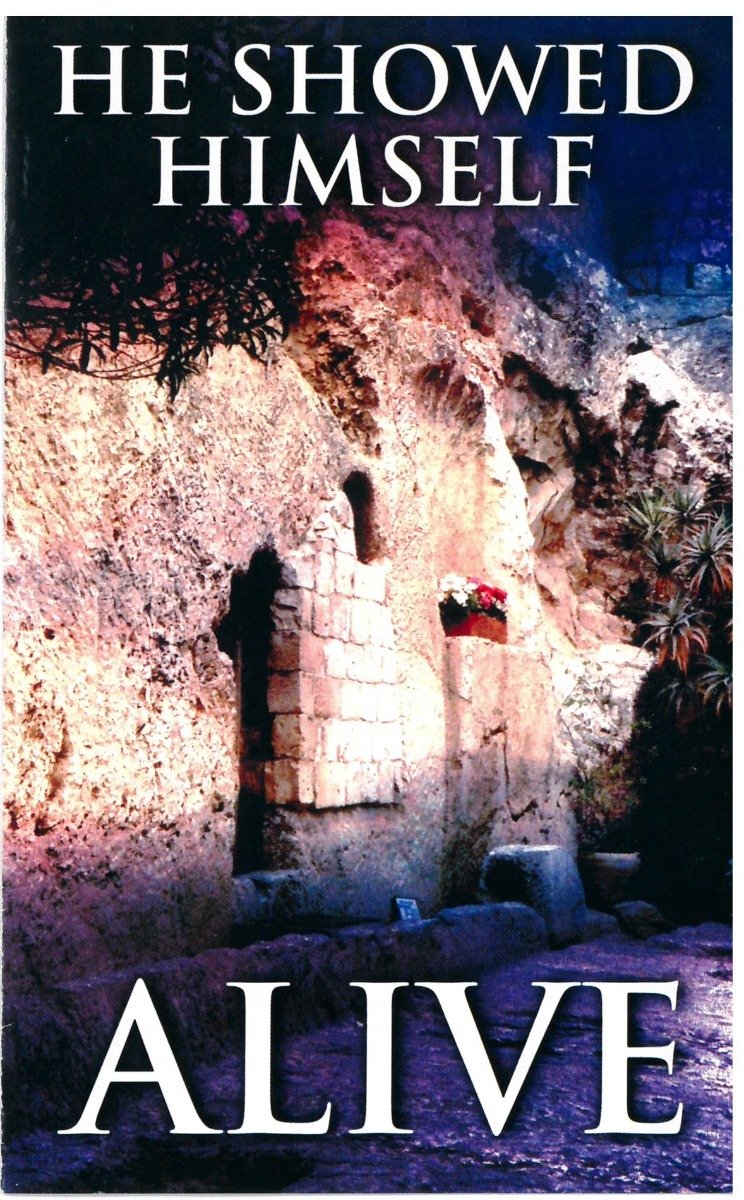
He Showed Himself Alive
Order code 150226-2
£0.05
Order by telephone or email
Quote order code 150226-2.
Call +44 (0)20 8316 5389 Email us
Open Monday to Friday, 9.00 am – 1.00 pm and 2.30 pm – 5.30 pm.
Details
Il was a sad, dark day when they crucified Him. For three and a half years Jesus of Nazareth had moved publicly among the people - in Galilee, in Judea, and in Samaria. Many had felt His touch during those years He had calmed many a fevered brow, healed many a diseased body, mended many a broken heart. But now He was dead!
After a long, lonety night of mockery and abuse He was led outside Jerusalem, to die at Calvary. They had nailed Him to a cross at nine o'clock in the morning and for three hours under a burning eastern sun He hung there in agony. Suddenly, at noon, a supernatural, unnatural darkness covered the whole land until three in the afternoon. Then He cried, "My God, My God, why hast Thou forsaken Me?" Then, with a loud voice He cried again, "lt is finished! " and He bowed His head in death.
But, we must ask, why did God forsake Him? He was, after all, God's Son, His beloved only Son. For thirtythree years He had lived a sinless life, as no other man had ever lived, and had enjoyed constant fellowship with His Father. Why should God forsake Him now?
The New Testament glves us the answer. Peter writes, "He bore our sins in His own body on the tree" (1 Peter 2.24). He was a holy sin-bearer on behalf of others. With no sin of His own He voluntarily became accountable for the sin of other people. The prophet's words were fulfllled, "He was wounded for our transgressions, He was bruised for our iniquities" (Isaiah 53:5). Those who accept Him say simply, "He died for me".
In the late aftemoon, of that same day two friends buried Him, and for three days His body lay in the cold silence of a tomb in a garden. But then, on the third morning, the first day of a new week, the stone which had sealed the tomb was miraculously rolled away, showing it was empty, except for the grave clothes in which He had been wrapped. These lay undisturbed, still in their folds, vacated by a now risen Lord and Saviour.
lt was all the evidence of a miracle. But who had rolled away the stone? How were the grave clothes left undisturbed but the body gone? "Why seek ye the living among the dead?" the angels ask the visitors to the now empty tomb. ''He is not here: for He is risen, as He said." Jesus was alive!
This is the Easter story. The empty tomb is an attested fact. Neither Roman nor Jewish authorities disputed it. Sceptics ever since have struggled with feeble explanations. But the truth is simple. The crucified Saviour is alive from the dead. God has thus declared that the sacrifice offered at Calvary has fully satisfied His righteous claims, and provides the means of
forgiveness for all who will accept Christ's work for
them.
The events of the six weeks between Christ's resurrection and His ascension to heaven, are summed up in those words, "He showed Himself alive" (Acts 1:3): to individuals and to small
groups, and on one occasion to more than five hundred people
all at once. "lt is I Myself," He had said, "Behold My hands... My
feet... My side." The Crucified One was alive!
He is indeed a risen Saviour. He is now in heaven. He is able and
willing to save every repentant sinner who will receive Him. You
can come to Him now. Trust Him as Saviour and acknowledge
Him as Lord and you will receive the forgiveness of your sins and
the assurance of a place in heaven with Him.
This is WHY He died, and rose again.
Jim Flanigan
More information
| Pages | 4 |
|---|---|
| Binding | Tract |
| Language | English |
| Subject | Evangelistic |
| Size | 16 × 10 cm |