
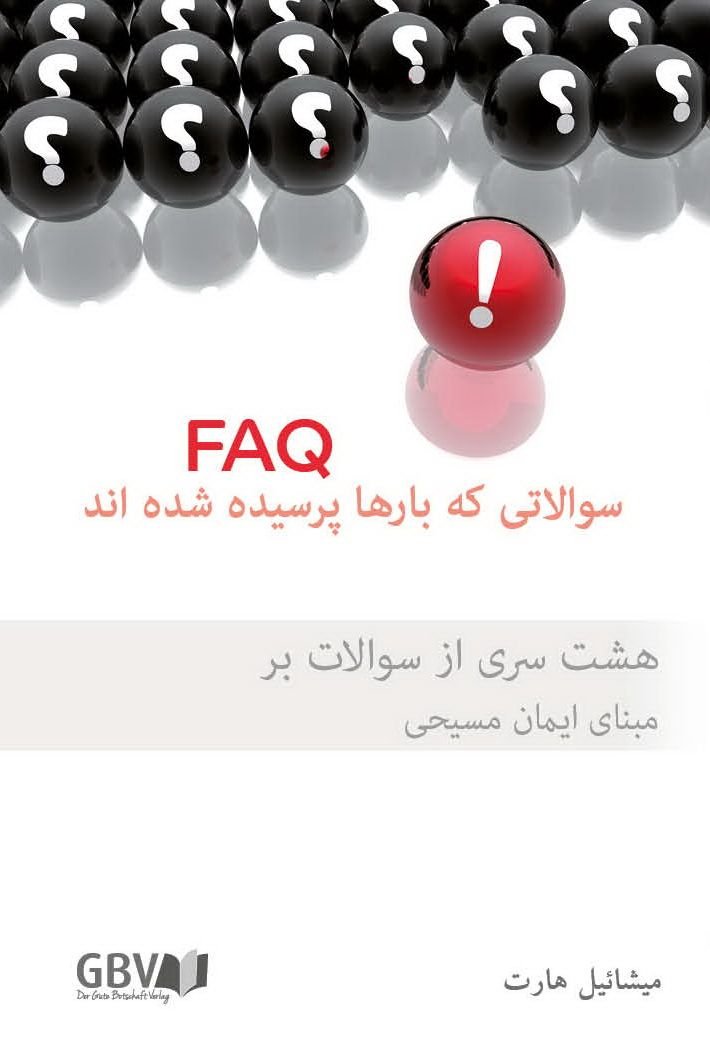
Farsi, FAQ, Frequently Asked Questions
Order code 350490
£1.75
The intention of this book is not to replace detailed and intensive study of the Word of God but rather to encourage the young reader to get started with the systematic study of the truth: "The faith once delivered unto the saints" (Jude 3).
What does the Bible teach?
Order by telephone or email
Quote order code 350490.
Call +44 (0)20 8316 5389 Email us
Open Monday to Friday, 9.00 am – 1.00 pm and 2.30 pm – 5.30 pm.
Details
FAQs - Frequently Asked Questions
Over the past few years, the use of the term 'Frequently Asked Questions' has become more and more widespread in all areas of life, no doubt with a view to responding to the need to absorb large quantities of information in the very limited time available to those who seek to learn about the subject matter in question.
The intention of this book is not to replace detailed and intensive study of the Word of God but rather to encourage the young reader to get started with the systematic study of the truth: "The faith once delivered unto the saints" (Jude 3).
What does the Bible teach?
Eight series of frequently asked questions on Bible topics:
The Lord Jesus Christ - His Person
Who is Christ?
What is Christ then, a man or God?
Are there any other Bible references that show Christ was God?
But how can He be God and, at the same time, the Son of God?
What do we mean by 'Trinity'?
Do Christians believe in more than one God?
Are there different ranks in the Godhead?
Are there relationships between the persons of the Godhead?
Why is it so important that Christ was and is both God and man?
When did Christ become a man?
When He became man, did He cease to be God?
Will Christ ever cease to be a man?
Did He have a human spirit, a human soul and a human body?
Was He a man just like us?
If Christ could not sin, how could He be tempted?
Was Joseph His natural father?
Was Mary His natural mother?
Does Mary, therefore, have a special place and, if so, what is it?
The Lord Jesus Christ - His Sufferings
Is the death of Jesus Christ sufficient for everyone to be forgiven?
Will everyone be forgiven?
What is propitiation?
What is substitution?
What is atonement?
Does atonement imply divine judgement?
Does atonement include liberation from physical suffering?
What is redemption?
What is purchase?
When did the Lord Jesus bear the sins of those who believe in Him?
Why was the Lord Jesus forsaken by God?
Was He ever forsaken by His Father?
Was He still forsaken by God when He died?
How do we know God accepted the price Jesus paid?
Could anyone have been saved through the Lord's righteous life?
Why is it serious error when some teach that a saved person can lose his salvation?
What is reconciliation?
Will all men be saved in the end?
What is universalism?
The Lord Jesus Christ - His Offices
What does the Lord do as our Great High Priest?
What does the Lord do as Advocate?
Will Christ reign as king over this earth?
Why is this important?
When will this be, and how long?
What will it be like in the Millennium?
Is it right for Christians to call Christ their 'King'?
What is meant by the 'Lordship of Christ'?
Is Christ the Lord of believers only, or also in relation to unbelievers?
What is meant by 'Headship of Christ'?
The Lord Jesus Christ - His Return
What do Christians wait for?
Are there any prophecies that have to be fulfilled before the rapture?
What does the rapture mean for Christ?
What does the rapture mean for those who belong to Christ?
How do we know there will be a 'tribulation period'?
What, then, do we mean by 'the tribulation'?
What saints will go through the tribulation?
Do Christians face trials and tribulations?
What is the 'Day of the Lord'?
When will the 'tribulation period' happen?
What happens in the middle of the 'tribulation period'?
What do we mean by the 'appearing of Christ'?
What does the appearing of Christ mean for Israel and Western Europe?
What does the appearing mean for Christ?
What does the appearing mean for Christians?
The Gospel of Salvation - Justification from Sins
What is the meaning of the word 'Gospel'?
What is the subject of the Gospel?
Why was Paul not ashamed of the Gospel (Rom. 1:16, 17)?
What is the righteousness of God?
Who needs the Gospel?
Is everybody guilty? Are there no exceptions?
Is there no solution?
What does it mean to be 'justified' (Rom. 3:20)?
What is meant by 'works of the law' (Rom. 3:20)?
So how can anyone be justified then before God (Rom. 3:22-25)?
What is meant by 'Whom God hath set forth to be a propitiation...' (Rom. 3:25)?
How can God justify a sinner and at the same time be just?
What about Old Testament Saints? How were they justified (Romans 4)?
But does not James say that Abraham was justified by works?
Why was Christ raised for our justification (Rom. 4:25)?
What are the consequences of justification (Rom. 5:1)?
What are the practical consequences in our lives?
The Gospel of Salvation - Deliverance from the Power of Sin
What is the difference between sin and sins?
What is the divine solution for sins and for sin?
Is a believer still under the power of sin?
What are the two families in Romans 5?
What is the consequence of belonging to the family of Adam?
And what characterises those who belong to the family of Christ?
So, if I have become part of the family of Christ by grace, can I continue to sin?
Why is inexcusable for a believer to continue in sin (Rom. 61)?
So, how is it that, at times, I still commit a sin? Am I not dead with Christ?
What is meant by 'our old man is crucified With him (Rom. 6:6)?
What is meant by the expression 'the body of sin'?
The problem of our SINS is solved by the death of Christ for us. But how is the problem of SIN and its power solved?
What is the meaning of baptism?
So how do I know that I have died with Christ? Can I feel it?
If I have died with Christ, how does that affect my relationship with SIN?
If I have died with Christ, what does that mean practically in my daily life?
Should a believer keep the law (or certain rules) to make sure he does not sin (Rom. 7:1-6)?
How, then, can a believer live in a way that pleases God?
Who is the 'l' in Romans 7:7-25?
What is this person's problem?
What does this person discover (Romans 7:17-24)?
The 'l' in Romans 7 has now understood that he cannot pull himself out of the mud. Where does help come from?
What conclusion is reached in chapter 7?
So can a believer ever be condemned by God (Romans 8:1)?
What is meant by the 'law of the Spirit of life' and 'the law of sin and death' (Romans 8:2)?
What is God's solution for sin (Romans 8:3)?
Does this mean that believers keep doing things which were forbidden under the law? Why not? (Romans 8:4)
How does 'walking in the Spirit' work practically?
But does a believer always walk in the Spirit?
How can we make sure we walk in the Spirit?
What does God do to help us walk in the Spirit?
If our salvation is so complete, why do many believers still suffer in their bodies and die? Is the body not included in our salvation?
Has God predestinated anyone to condemnation?
The Church Today...
What does the word 'church' mean?
What is the Church?
When did the Church begin?
Is the church revealed in the Old Testament?
Who does the church consist of today?
How do you become a member?
Why does the New Testament use pictures to describe the church?
What do we mean by saying the church is the body / house / bride of God?
What do we mean by 'the church of God in a particular place?
What does it mean to be 'gathered to the Lord's name'?
What is a church (or 'assembly') meeting?
Who conducts the meetings (is this the role of pastors and/or elders?)?
Who should give ministry of the Word?
What is the difference between gifts and offices?
Should we appoint elders?
What gifts are mentioned in the New Testament?
The miraculous gifts... What was their role? What is their role today?
What do we mean by 'the ruin of the church'?
How can you show the unity in a time of ruin and fragmentation?
Who should be received for the breaking of bread?
What is the relationship between local meetings?
What is assembly discipline?
What is a sect?
Are 'we' a denomination?
How do we relate to other Christians who do not meet with us?
What is more important: to be doctrinally correct or be devoted to the Lord?
The Inspiration of the Bible
Is it true that the Bible is inspired by God?
Does inspiration really matter?
What exactly does inspiration mean?
Did the writer's personality play no part at all in the end product?
Is the end product therefore human and therefore imperfect?
How can the Word bear the marks of the writers and at the same time be the Word of God?
Did the Lord ever correct anything the Old Testament writers had written?
Did the writers understand what they were writing?
Did God give the words, or merely the concepts?
Why is verbal inspiration so essential?
Does inspiration relate to the whole Bible? Or only to the doctrinal parts?
Does the Bible claim to be God's Word?
What exactly is inspired, the original writings, the manuscript copies, or our translations?
But aren't the copied manuscripts full of mistakes?
But aren't the translations very imprecise?
So an English Bible is not the inspired Word of God, then?
Did the Lord comment on whether or not the Old Testament was inspired?
How do we know the New Testament is inspired as well?
How do we know that the right books were chosen to make up the Bible?
But aren't there contradictions in the Bible?
What about the words spoken by evil people and recorded in the Bible?
So, in summary then, what does the Bible say about itself?
But can we rely on the Bible's own testimony about itself?
More information
| Author | Hardt, M. |
|---|---|
| ISBN | 9783961625406 |
| Pages | 144 |
| Binding | Paperback |
| Language | Farsi |
| Subject | Bible Study |
| Size | 18 × 12 × 0.8 cm |